A Practical Direct-to-Consumer eCommerce Strategy

The Situation
A multi-category brand manufacturer in the floor covering market wanted to grow its direct-to-consumer business through online marketplaces. The company had a broad product catalog and an established retail business, but it needed a better way to manage product data, inventory, orders, advertising, and marketplace requirements across several sales channels.
The timing made sense. In 2023, U.S. eCommerce sales reached about $1.1 trillion, according to analysis of U.S. Department of Commerce data. Online sales also continued to represent a meaningful share of retail, with Digital Commerce 360 reporting that eCommerce accounted for about 22% of total U.S. retail sales in 2023.
Marketplaces were also becoming a larger part of online retail. Forrester projected that two-thirds of global B2C eCommerce would come from marketplaces in 2023. For brands and manufacturers, this created a practical opportunity to reach more shoppers without relying only on their own website, wholesale accounts, or traditional retail channels.
The client had already tried to sell on marketplaces using another platform, but the process was difficult. Product listings were hard to syndicate. Marketplace errors took too much time to review and fix. Product content had to meet different requirements by channel. The client also had limited internal experience working directly with marketplace teams and marketplace APIs.
The client needed a system that could support a larger catalog, reduce manual work, and give the team a clear process for launch and ongoing management. Acenda was engaged to provide the technology, onboarding process, marketplace operations support, and campaign structure needed to support the direct-to-consumer strategy.
Acenda’s platform and strategy team focused on several practical questions:
- Which marketplace channels fit the brand’s current business strategy?
- Which channels should be added later as the program grows?
- How should product content be structured for each marketplace?
- How can product listings be syndicated across multiple marketplaces without duplicating work?
- How can inventory, order routing, and tracking updates be managed from one platform?
- How can a small internal team manage thousands of SKUs and orders?
- How should marketplace errors be reviewed, prioritized, and fixed?
- How can advertising campaigns be organized to support return on ad spend?
Our Approach
Acenda created a phased launch plan to help the client move from planning to production. The goal was to build a process that could work at launch and continue to support day-to-day marketplace operations after the first wave of products went live.
The work covered product data review, marketplace template setup, integration configuration, quality assurance, error remediation, account training, reporting, and advertising support. Each phase was designed to reduce manual steps and make it easier for the client’s internal team to manage the program inside Acenda.
Onboarding
The onboarding phase started with a review of the client’s business goals, catalog structure, fulfillment process, and marketplace requirements. Acenda’s onboarding and business development teams worked together to confirm the launch plan before moving into configuration.
- Reviewed client needs with the onboarding and business development teams.
- Held a kickoff call to review product content, fulfillment rules, inventory sources, and order flow.
- Built product templates based on marketplace requirements and client catalog structure.
- Created client-specific instructions for product data preparation.
- Configured webstore, marketplace, order service, and fulfillment integrations.
- Confirmed roles, responsibilities, and launch milestones with the client.
Production
During production, Acenda reviewed the client’s product data and mapped it to the requirements of each marketplace. This included titles, descriptions, images, attributes, categories, variation data, pricing, inventory, shipping settings, and other channel-specific fields.
- Analyzed product data for completeness and marketplace readiness.
- Identified missing, inconsistent, or incorrectly formatted product fields.
- Sent feedback and data requests to the client where more information was needed.
- Built API-driven posting templates for each marketplace.
- Customized product fields by channel to meet marketplace rules.
- Prepared a catalog of more than 10,000 SKUs for marketplace syndication.
Quality Assurance
Before launch, Acenda tested product data, inventory updates, order flow, and fulfillment routing. This step helped confirm that products could be listed correctly and that orders could move through the connected systems without unnecessary manual work.
- Tested order flow from marketplace to Acenda and downstream systems.
- Tested inventory sync to confirm updates were being sent correctly.
- Reviewed product data a second time before launch.
- Checked channel-specific attributes, categories, and variation structures.
- Completed test orders and confirmed expected results.
- Received client sign-off on product data and order testing.
Launch and Error Remediation
Once testing was complete, Acenda syndicated the product catalog to the selected marketplaces through API connections. Marketplace errors were reviewed inside Acenda so the team could identify issues, fix data, and resubmit products.
- Syndicated more than 10,000 SKUs through marketplace APIs.
- Reviewed listing errors returned by marketplace APIs.
- Prioritized errors based on impact and SKU volume.
- Updated product data and resubmitted listings as needed.
- Used automated checks to monitor data consistency across channels.
- Helped the client move from launch activity into a repeatable operating process.
Maintenance
After launch, Acenda supported the client with training, account management, reporting, and marketplace operations. The goal was to help the client manage catalog updates, orders, inventory, reporting, and seasonal planning from one platform.
- Provided platform training with an Acenda account manager.
- Held weekly status calls to review progress and open items.
- Supported compliance and settlement reporting.
- Reviewed sales results and marketplace performance.
- Planned seasonal product launches and catalog updates.
- Helped the client manage product data and orders within Acenda.
Promotion
Acenda also supported the marketplace promotion strategy. Product feeds and campaigns were organized so the client could review performance by product group, marketplace, and campaign objective.
- Optimized product feed APIs for marketplace advertising programs.
- Grouped campaigns based on product type and performance goals.
- Reviewed campaign performance and reporting.
- Adjusted campaign structure based on sales, spend, and return.
- Supported product-level visibility across selected marketplaces.
The Results
The client used Acenda to support a direct-to-consumer marketplace strategy across multiple channels. The program combined marketplace integrations, product content management, order routing, inventory updates, reporting, and promotional support in one operating process.
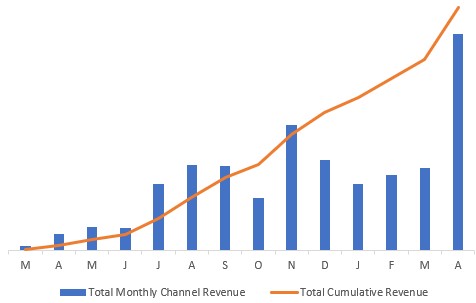
During the first year, the strategy was trending toward more than $15 million in annual sales revenue. The client also saw a triple-digit percentage increase over the prior year. This growth came from a more complete marketplace presence, a cleaner product syndication process, faster error remediation, and a more structured approach to marketplace promotion.
The project also helped reduce the amount of manual work required to manage a large marketplace catalog. With more than 10,000 SKUs being syndicated through API connections, the client could manage product content, orders, inventory, and marketplace feedback through Acenda instead of relying on disconnected spreadsheets and manual channel-by- channel updates.
The result was a more organized direct-to-consumer marketplace program. The client had a clearer process for launching products, fixing listing issues, reviewing performance, and planning future marketplace growth.